
Mille Lacs Projected Release Dates
A projected date is an administrative estimate based on the sentence, governing law, credited time, and current correctional record. An actual date records what happened after the jail or prison completed release processing. The two may match, but they answer different questions. A court can pronounce a sentence without calculating every later correctional adjustment, while DOC computes the prison and supervision portions under the law that applies to that person.
A pretrial detainee generally has no fixed sentence-release date. Departure may depend on bond, conditions, dismissal, a court order, another warrant, or case resolution. Even a court release order does not give the exact time the secure facility will finish identification, property, paperwork, and hold checks. For a person serving a local jail sentence, the sentencing order, jail-credit record, and Booking are the sound sources. A state prisoner follows the MN DOC route.
| Date type | What it establishes | Best Mille Lacs source |
|---|---|---|
| Court event date | When the judge entered bail, sentence, release, or another order | MCRO register and court documents |
| County estimate | A possible local jail release based on the order and jail credit | Mille Lacs Booking and maintained jail records |
| DOC projection | The current state correctional calculation shown on the live record | MN DOC public viewer or DOC |
| Actual release | The date and time custody ended or changed | The holding agency's release or transfer transaction |
Find Mille Lacs Inmate Release Dates
Identify the custody system before searching. Mille Lacs County's public locator is an in-custody product. It does not advertise a released-person archive, and its underlying interface does not prove that any possible release-date field is populated for each public record. Absence from that roster is not a date. It can also follow a transfer, spelling mismatch, or update delay.
- Search the county in-custody locator and record the spelling, booking detail, and search time. Treat a no-match only as a reason to continue.
- Call Mille Lacs County Jail Booking at 320-983-8244. Ask whether the specific booking is active, was released to the community, or was transferred.
- Open Minnesota Court Records Online. Read the Mille Lacs case for bail, sentence, jail credit, commitment, warrants, and later orders.
- If the person was committed to the commissioner, search the MN DOC public viewer by MNDOC number or name. Compare identifying details and read the live status with any displayed date.
- For a historical county event, request the release or transfer transaction under the Minnesota Government Data Practices Act. Ask for the date, time, legal basis, and receiving agency when public.
- After the expected event, confirm actual release through the holding agency. Do not substitute a projection or roster disappearance.
The search screen captured from the official MN DOC public viewer can help locate a state correctional record. The research could not reliably establish a universal live date-field label, so the wording shown on the current individual result must be read as written.
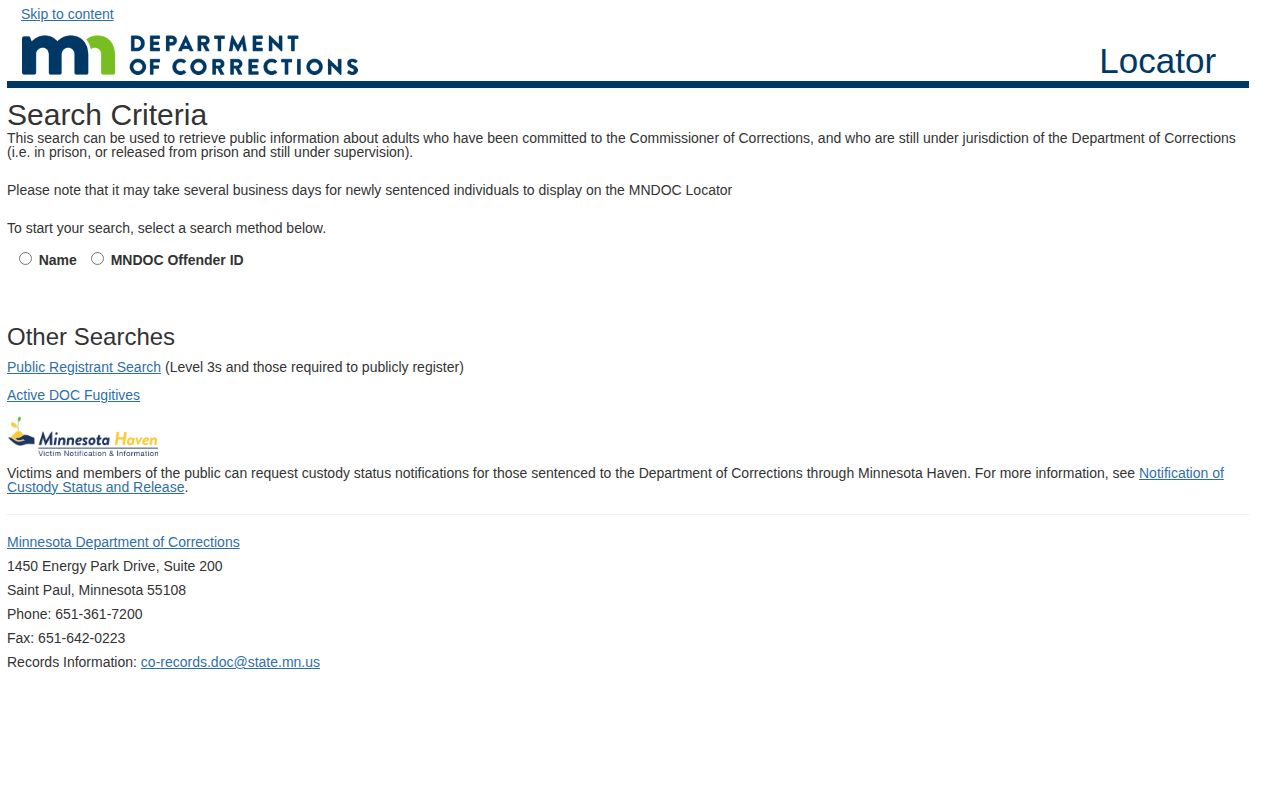
A county-only booking may never appear there. Use the state viewer only after a prison commitment or another known DOC relationship.
Note: Search by MNDOC number when available, then compare the offense, commitment county, age information, aliases, and photograph on the result.
Minnesota Prison Release Formula
Minnesota's ordinary rule is not a generalized national percentage. For the standard fixed executed felony sentence covering offenses committed on or after August 1, 1993, Minnesota Statutes section 244.101 divides the sentence into a minimum imprisonment term equal to two-thirds and a maximum supervised-release term equal to one-third. Supervised release is the community part of the sentence, not full discharge.
The baseline does not mean every person spends the same share behind a prison wall. Court-awarded jail credit, consecutive sentences, discipline, special conditional-release provisions, detainers, and other governing rules can affect the calculation. A court explains the total pronounced sentence and expected split, but DOC maintains the correctional computation. The live record and DOC calculation control over an informal online calculator.
Older cases can follow older law. Section 244.04 preserves specified historical good-time rules, including a reduction structure for certain pre-August 1993 offenses. Mandatory life sentences and modern offenses are excluded from that ordinary provision. “Good time” should therefore not be used as a catchall term for every reduction now available in Minnesota.
- Executed sentence
- The custodial sentence ordered for service, subject to the governing correctional rules.
- Jail credit
- Time the court credits toward the sentence for qualifying prior custody.
- Supervised release
- The community portion of a Minnesota prison sentence.
- Conditional release
- An added or specialized release term required by a governing statute.
- Detainer
- A request or legal hold from another authority that can prevent community release.
Minnesota Earned Release Credit
The Minnesota Rehabilitation and Reinvestment Act creates an earned incentive release credit framework that is separate from historical good time. Section 244.43 requires DOC policy for earning credit through goals in an individualized rehabilitation plan. Section 244.44 governs how credit is applied, while section 244.45 identifies groups that are not eligible.
Current law caps the credit at 17 percent of the total executed sentence and does not permit imprisonment to fall below half of that sentence. The supervised-release term is not lengthened by the credit. Eligibility alone does not reduce a date. The person must earn the credit, DOC must award it, and current law permits revocation for facility-rule violations or criminal acts while incarcerated.
Implementation is phased. DOC reported in December 2025 that revised policy implementation would begin at selected prisons in February 2026 and proceed through four phases, with full implementation expected by the end of 2027. That schedule is another reason not to subtract 17 percent from every public sentence. Ask DOC what credit has actually been awarded in the individual computation.
Life sentences, old indeterminate sentences, and people governed by old good-time or similar provisions are among the ineligible groups described in the current framework. Case dates matter. The correct law is tied to the offense, sentence structure, and correctional classification, not merely to the year someone searches the record.
Mille Lacs Release Date Changes
A projected date can move for lawful reasons after the first computation. Some changes affect the prison term. Others do not change the sentence at all but redirect the person into another agency's custody. Read the factor beside the status and controlling location. A transfer date should never be described as freedom from all custody.
| Factor | Possible effect | Where to verify |
|---|---|---|
| Amended sentence or jail credit | Changes the term or the credited starting point | Court order and DOC computation |
| Disciplinary confinement | May increase time imprisoned under the governing rules | DOC record and authorized DOC response |
| Earned incentive credit | May reduce imprisonment only when eligible, earned, and awarded | DOC computation |
| Detainer or warrant | Can route the person to another county, state, federal, or immigration authority | Holding and receiving agencies |
| Consecutive sentence | Requires another term to be served in sequence | Judgment and DOC calculation |
| Conditional-release term | Adds a statutory community-control period or affects the release structure | Statute, judgment, and DOC |
| Board action | Can set conditions, continue review, or establish a future projection for an eligible case | Board minutes and later DOC status |
The Minnesota Supervised Release Board applies only to limited eligible classes. Most modern determinate sentences do not hinge on a discretionary parole vote. For an eligible life, indeterminate, youth, or specified case, a Board projection can still depend on an approved release plan, detainer verification, conditions, and later action.
Note: A projected date is a snapshot of the current legal and administrative calculation, so record the date checked and confirm again later.
Mille Lacs Weekend Release Rules
Minnesota Statutes section 244.05, subdivision 1a contains an offense-date-specific rule for certain state-prison supervised releases near Fridays, weekends, and holidays. For covered crimes before August 1, 1992, a release scheduled on Friday, Saturday, Sunday, or a holiday moves to the last prior day outside those categories. For crimes on or after that date, the covered release moves to the first later day that is not Friday, Saturday, Sunday, or a holiday.
That provision should not be copied onto a Mille Lacs County jail sentence. No official local jail good-time rule or weekend-release policy was found in the reviewed county sources. The jail's “24-hour door” refers to physical access, not a promise that every release is processed at any chosen time. First appearances occur on business days under the county's published inmate procedure, but case-specific release timing still depends on the court and Booking.
For a local sentence, inspect the judgment, credited days, and any later order. Then ask Booking how the maintained record calculates the expected end. For a state sentence, apply the state rule only after checking the offense date and exact statutory coverage. A broad weekend assumption can move the expected date in the wrong direction.
Mille Lacs Release Date Channels
Each channel answers a narrow question. The Mille Lacs jail can confirm its own booking, release, or transfer transaction. MCRO can show the order, sentence, jail credit, warrant, and probation event. The DOC public viewer covers people committed to the commissioner, including those imprisoned or released from prison while still under supervision. VINE reports county-jail status and registered events, while Minnesota HAVEN handles eligible DOC prison notifications.
For a pending county release, call Booking at 320-983-8244. For an old event, use the county Data Requests route and seek the existing release or transfer fields. Minnesota Statutes section 13.82 identifies maintained adult release and transfer data as public at all times, subject to other lawful protections. Ask for an electronic copy and for the legal basis of any redaction.
For a future county-jail custody change, the Mille Lacs County VINELink release check can send an alert. It cannot compute a state-prison sentence and does not replace the actual release record. For a prison case, recheck DOC and use Minnesota HAVEN when eligible. For BOP, ICE, or USMS custody, switch to the appropriate federal locator or docket rather than trying to force a county or DOC date onto the case.
The most reliable answer pairs the projected source with later event proof. Save the court or DOC basis for the estimate. After the expected day, confirm the actual date and whether the event was community release, supervised release, or transfer. The general Mille Lacs County released inmate search lays out the complete released-first sequence for cases whose custody system is not yet clear.